Sometimes, when I read the various blogs I subscribe to or scroll through my Facebook and Instagram feeds, I wonder how everybody but me manages to make everything work all of the time. I realize that's not the case, but it is easy to be caught up in the perfection projected by so many on social media.
Where are the posts about the days that just don't work?
Because I could use one of those right now to let me know that I'm not the only one who is having a hard time keeping it all together.
Don't get me wrong... I love my kids and I love my school and colleagues. My struggle right now has nothing to do with them and everything with me. Each day when I sit in my room after the kids have gone and reflect on the day, I am left with the feeling that something's just not right. I can't figure out what that thing is, but I can feel it.
Maybe it's the fact that last year at this time, I was running on pure adrenaline. I was learning so much as I went that I barely had time to think about how things were going. Maybe it's also the fact that it's easy to forget what the beginning of the school year is like - I remember how smoothly everything ran in late May but not necessarily all of the hard work it took to get there.
Maybe it's the fact that I'm hard on myself. I know what I do MATTERS, that I have a huge responsibility to do the very best every day for the kids in my class. I don't cut myself much slack, and I don't really like to ask for help, even when I know that I should.
So here I am, staring week four of the school year in the face, and I'm wondering when I'm going to hit my groove. It'll come... I know. And if it's like past years, there will be a moment when everything just clicks and I'll be on my way.
And next year, when I'm thinking about how hard the beginning of the school year is, I can look back and read this and remember that I've been here before.
Showing posts with label Teaching. Show all posts
Showing posts with label Teaching. Show all posts
Sunday, September 10, 2017

Monday, September 4, 2017
Get off the train, Mindi!
 |
| Photo via Creative Commons. Attribution here. |
I am about to start my third week of school. As I sat at my desk at school yesterday (yes, I went in on Sunday), surrounded by my teacher's editions and unit plans, I began to feel a twinge of familiar anxiety - how am I going to get everything done that I need to get done so that my kids learn as much as possible during their third grade year? How much more quickly can I move through the math chapters so that I cover all of the important concepts before PARCC testing? How are we going to finish this social studies unit before we switch over to science? Chug...chug...chug....
This feeling of faster...faster...chug...chug... is a familiar one for teachers. Pacing guides, teacher's editions, and the publishing of test scores underscore this need to move and move quickly. And to be honest, we want to make sure our kids are learning and growing as much as they can in their 180 days in our care. We want to be effective. We want to do our jobs well.
But here's the thing. Getting on the curriculum train doesn't help our kids. "Coverage" of content does not guarantee a student is deeply learning. I have to constantly remind myself to slow down, to allow time for my kids to think about what they're reading, writing, and learning, to encourage them to explore the aspects of our curriculum that they are especially interested in, and to allow them time to research their own passions and then share their learning with the class.
I've seen for myself the difference in learning when I make myself slow down and let the kids show me what they need and when they're ready to move on. When I ask the class what they're interested in learning about and then let them go, I find that they usually hit the learning targets the district has set out for the unit and much more. They are also learning other skills... how to develop a research question, how to seek out and synthesize information, how to present that information in a way that is interesting and compelling. And more importantly, they are engaged in their learning and excited about it. THIS is what will make a difference in their retention of new knowledge.
To be honest, this has been easier for me to do in my literacy block and science and social studies periods than it has been in math. I think this is mostly because I lack the deep understanding of mathematical practices that I have in literacy. I've written about this before, and the work of learning the "why" behind math is work I continue to do. The pacing guide in math also contributes to this as well. It's a much tighter progression through the units than we have in the other subjects. Luckily, I have colleagues who can help me work through how to make the math learning deep and meaningful rather than just surface knowledge that is easily forgotten.
So here I am, at the beginning of my third week of school, reminding myself to get off of the train, to listen to my heart and my kids, to take a deep breath and dig in to the work that matters.
Tuesday, August 29, 2017
Building Stamina

Students, too, have this transition.
They, and I, have to build stamina to do the hard work of learning and growing.
The kids have to get used to using their Level 0 or 1 voices during the literacy studio and I have to get used to talking to both the whole class and small groups, and more importantly, giving ample wait time. We all have to get used to eating lunch later than we might like and waiting longer than we might like to go to the bathroom.
We often think about building stamina within the definition of the literacy block. At the beginning of the school year, students and teachers work on building stamina in silent reading. Each day the students should be able to read without getting distracted for a longer period of time. We might also talk about writing stamina - the length of time a student can write, which hopefully gets longer each day.
I've had to do some serious thinking about my classroom management and stamina this week. The things that worked for me last year don't seem to be working this year. I need to really take a step back and do some kid-watching in order to make decisions about changes we (because it will take BOTH the kids and me to change things) need to make in order to create an environment conducive to learning. I have to remember that when I think about last year, I am remembering END of the year third graders, but the kids who are sitting in front of me are BEGINNING of the year third graders. Some of them are just now turning eight. I have to remember to cut us all some slack as we adjust to each other and build our learning community.
So tonight as I sit here thinking about the year so far, I am kind of ok that I need to make a course correction. If I thought things were PERFECT, I'd be deluding myself. Instead, I need to be realistic but also pragmatic. I need to remember that this school year is a marathon and not a sprint.
And marathoners need stamina.
Saturday, June 10, 2017
Recommended Reading from Room 301
The school year just ended and I have some things I need to write about, but I'm still processing the school year that was. For today, I've decided to share the titles my third graders have designated as "must reads." Here for you, in no particular order, are their favorite books from this year. If they are books I've written about over at NextBestBook, I've included the link.


- Fake Mustache by Tom Angleberger
- Cody and the Mysteries of the Universe and Cody and the Fountain of Happiness by Tricia Spring Stubb
- The Nancy Drew books by Carolyn Keene
- I Could Not Keep Silent: The Life of Rachel Carson by Clare Meeker
- The Truth About Twinkie Pie by Kat Yeh
- Honey by Sarah Weeks
- Mr. Pants by Scott McCormick
- Upside Down Magic by E. Lockhart, Lauren Myracle, and Sarah Mlynowski
- Book Scavengers by Jennifer Chambliss Bertman
- Firefly Hollow by Alison McGhee
- Close to Famous by Joan Bauer
- One for the Murphys by Lynda Mulally Hunt
- The Baby Sitters Club graphic novels by Raina Telemeier
- The Amulet series by Kazu Kibuishi
- The Percy Jackson series by Rick Riordan
- The Great Book Eating Boy by Oliver Jeffers
- Adventure According to Humphrey by Betty G. Birney
- Pie by Sarah Weeks
- Jack by Liesl Shurtlif
- The Day the Crayons Quit and The Day the Crayons Came Home by Drew Daywalt
- The Kindness Club by Courtney Sheinmel
- Wish by Barbara O'Connor
- Gabby & Gator by James Burks
- Lady Pancake & Sir French Toast and The Case of the Stinky Stench by Josh Funk
- Dog Man by Dav Pilkey
- Amina's Voice by Hena Khan
- Moo by Sharon Creech
- A Snicker of Magic by Natalie Lloyd
- The Harry Potter series by JK Rowling
- The Diary of a Wimpy Kid series by Jeff Kinney
- Like Pickle Juice on a Cookie by Julie Steinberg
- Save Me a Seat by Sarah Weeks
- The Dork Diaries by Renee Russel
- Drita, My Homegirl by Jenny Lombard
- How to Speak Dolphin by Ginny Rorby
- The Anna,Banana series by Anica Mrose Rissi
- When I Grow Up: Misty Copeland by Lexi Ryles
- When I Grow Up: Sonya Sotomayor by AnnMarie Anderson
- Swindle by Gordon Korman
- Charlotte's Web by EB White
- We Are All Wonders by RJ Palacio
- Wonder by RJ Palacio
- Auggie & Me by RJ Palacio
- I Want My Hat Back and This Is Not My Hat by Jon Klassen
- 11 Birthdays, 12 Finally, 13 Gifts, and The Last Present by Wendy Mass
- Graceful by Wendy Mass
- A Mango Shaped Space by Wendy Mass
- Jeremy Fink and the Meaning of Life by Wendy Mass
- The Candymakers and The Candymakers and the Chocolate Chase by Wendy Mass
- The Happily Ever After series by Wendy Mass
- Fish in a Tree by Linda Mulally Hunt
Wednesday, April 12, 2017
I Love My School Day
If you were on Twitter on Tuesday, did you notice #LoveMySchoolDay? Teachers from across the country tweeted things they loved about their schools all day.

Just a few of mine:

I'm becoming more and more vocal about teachers telling their own stories about the amazing things that happen in classrooms and schools. When we tell our own stories, we control the narrative.
Teachers know what happens when others control the narrative. We hear things like:
- teachers are overpaid for only working 9-3;
- teachers can't be trusted, they need scripted curriculum;
- teachers are the reason for the achievement gap;
- teachers are glorified babysitters;
- teachers are greedy for expecting their pensions to be there when they retire;
- teachers get summers off.
- teachers care deeply about the children they teach;
- teachers in underserved communities feed, clothe, and supply their students with daily needs;
- teachers work all year round, even if we're not in our classrooms;
- teachers take their work home with them - not just the physical papers and books, but also the worries and joys that occupy our minds;
- teachers want to do a good job, and we're willing to work hard to do it;
- teachers are professionals who keep up with the latest research on best practice.
The need to control the narrative is part of the reason why I write in this space, even though few people read what I write. I am telling MY story; I'm putting the good things that are happening in my classroom out in the world. I'll keep chipping away here and on Twitter and on Facebook, making sure I do my part to counter the negatives that so many people insist on clinging to.
Think about it....
Who tells your story?
Tuesday, March 28, 2017
Putting one foot in next year
Over the weekend I received this email notification:

My reflection isn't due until the end May, about a week and a half before school ends, but to be real, I've been reflecting since the first day of school. I can't help it; it's how I operate.
But... here's the thing. When spring break rolls around, I start getting itchy to begin planning for next year. And every year I tell myself that it's too early; I still have a little over two months with my current students, and there's still so much to do.
It's not that I want to wish this current class away... I don't! I have the best class of third graders a girl could wish for for her first go at this grade level. They have taught me so much about patience, humor, and trusting them (and myself). I just keep thinking about how I could do things BETTER next year.
I'm a perfectionist. I know that I can be a better teacher than I am right now, and I am lucky to work in a district that provides me with the resources I need to grow. As I talk to colleagues and read their blogs and see their tweets, I am inspired to be better every day.
So what am I thinking about, sitting here on my couch in the middle of my spring break? What will I do differently next year?
Being a reflective practitioner is an important part of teaching. It's easy to sit back and think about everything that went well, and a bit harder to acknowledge the things that aren't so great. But if I am to truly grow as a teacher, I can't just stay in my comfort zone; I have to push myself to face my weaknesses and seek out the help I need in those areas.
So yeah... I have one foot in next year. But there's still one firmly planted in this year. And I owe it to my students to be fully focused on them until June 8.

My reflection isn't due until the end May, about a week and a half before school ends, but to be real, I've been reflecting since the first day of school. I can't help it; it's how I operate.
But... here's the thing. When spring break rolls around, I start getting itchy to begin planning for next year. And every year I tell myself that it's too early; I still have a little over two months with my current students, and there's still so much to do.
It's not that I want to wish this current class away... I don't! I have the best class of third graders a girl could wish for for her first go at this grade level. They have taught me so much about patience, humor, and trusting them (and myself). I just keep thinking about how I could do things BETTER next year.
I'm a perfectionist. I know that I can be a better teacher than I am right now, and I am lucky to work in a district that provides me with the resources I need to grow. As I talk to colleagues and read their blogs and see their tweets, I am inspired to be better every day.
So what am I thinking about, sitting here on my couch in the middle of my spring break? What will I do differently next year?
- My kids will write more. Looking back, I realize I put a HUGE emphasis on reading during my literacy studio, and I did not do enough writing instruction. Because my literacy block is almost 2 hours long rather than separated into a reading workshop and a writing workshop, it is easy to focus on just one of the areas. The whole idea of a literacy studio, though is to blend the reading and writing instruction as much as possible in order to build on the power of the reading/writing connection.
- My kids will share more. I am one of those teachers who KNOWS kids are supposed to share every day during literacy studio, but who doesn't remember to do that often enough. Don't get me wrong... the kids talk every day in lots of situations. But we don't SHARE our reading and writing lives enough. This is something I'm thinking about a lot. And it's something I can make myself remember to do when we return to school next week.
- My kids will do more inquiry-based learning in science and social studies. I tell myself that because this was my first year learning the new curriculum, it was ok to just follow the units as they were written. I know, though, that I've done a disservice to my students by not including them in the planning and learning as much as I could have. This needs to change.
- I will incorporate more choices into my math block. The expectation in my district is that our math block is really a math workshop, where there is a short mini-lesson followed by time when students have choice in their work while I pull small groups or confer with individual students. This did not happen most days, in large part due to my discomfort as a math teacher. I'm working on learning more about being a math teacher, so hopefully I will be able to make this better next year.
Being a reflective practitioner is an important part of teaching. It's easy to sit back and think about everything that went well, and a bit harder to acknowledge the things that aren't so great. But if I am to truly grow as a teacher, I can't just stay in my comfort zone; I have to push myself to face my weaknesses and seek out the help I need in those areas.
So yeah... I have one foot in next year. But there's still one firmly planted in this year. And I owe it to my students to be fully focused on them until June 8.
Friday, February 17, 2017
I used to be a literacy coach... and here's why I need one.
I am not a new teacher. In fact, this is my twenty-third year in my school district. Eighteen of those were spent teaching seventh grade language arts (and sometimes US history) and four of them were spent as a literacy coach.
As a coach, I worked with the teachers to improve literacy instruction across the curriculum. Surprising as it may seem, I spent most of my time working in math, science, and social studies classes rather than in the language arts classes. I loved going into these classes and thinking with the teachers about the challenges of incorporating reading, writing, and choice into their curricula and then working with them to implement the ideas we came up with together. I was always amazed at how we could take my knowledge of research in literacy education and pair it with their content expertise to find new ways to engage students in the hard work of learning.

Now, I'm back in the classroom, and I'm finally able to put all of the things I've learned over the past four years into practice. I know so much more about teaching and learning than I did when I first stepped away. I've had the opportunity to watch teachers and kids and think about engagement and learning. You'd think I'd be the best teacher I've ever been, right?
I am.
I am much more aware of limiting how much I talk so that my students can talk and think more. I provide my students with opportunities to make choices about their learning over the course of the school day. The feedback I give my students is clearer and more targeted than ever before. You'd think I wouldn't need to work with the literacy coach in my building.
You'd be wrong.
I've spent the past two months working closely with my coach because I want to continue to grow. Having Luanne come into my room to work alongside me provided the opportunity for me to discuss my teaching and my students' learning with a highly knowledgeable peer in a setting unrelated to my professional evaluation. She could make recommendations for next steps with particular students and small groups because she was in my class, getting to know the students as readers and writers, and we had many conversations about what to do to move students forward. This time with her in my class was important to my growth. In some ways, it validated me; it helped me to see that I DID remember how to teach after being in a support role. In other ways it challenged me by reminding me that my way was not the only, and perhaps not the best, way to approach a topic. I'll miss having Luanne in my room several times a week. She's now moving on to work with other teachers in our building.
I know not all teachers are lucky enough to have instructional coaches to support them in their work. But we can seek out coaches and mentors on our own. I know that I rely on one of my teammates to help me plan my math instruction - trust me... I need that help as I've never taught math before! I seek out Twitter chats such as #g2great and #3rdchat which focus on instructional practice in order to "meet" other teachers who are smart and innovative and help me push myself. This desire to continue to grow as a teacher is as strong as ever. It is important for all teachers to have this growth mindset. We need to be models of curiosity and life-long learning for our students. We need to keep up with the research and new thinking in our field.
So I think the thing I've been trying to write through today is the idea that as a teacher, I can never stop learning. I can never know all there is to know about my craft and there is always room to grow. Need a friend to read and discuss a professional book? Email me. I'm always a willing participant. Have a problem you need someone to think through with you? I'm your girl, as long as you'll do the same for me. Read a great book about teaching and learning lately? Tell me the title so I can buy it.
Because I honestly believe you can never learn too much.
As a coach, I worked with the teachers to improve literacy instruction across the curriculum. Surprising as it may seem, I spent most of my time working in math, science, and social studies classes rather than in the language arts classes. I loved going into these classes and thinking with the teachers about the challenges of incorporating reading, writing, and choice into their curricula and then working with them to implement the ideas we came up with together. I was always amazed at how we could take my knowledge of research in literacy education and pair it with their content expertise to find new ways to engage students in the hard work of learning.

Now, I'm back in the classroom, and I'm finally able to put all of the things I've learned over the past four years into practice. I know so much more about teaching and learning than I did when I first stepped away. I've had the opportunity to watch teachers and kids and think about engagement and learning. You'd think I'd be the best teacher I've ever been, right?
I am.
I am much more aware of limiting how much I talk so that my students can talk and think more. I provide my students with opportunities to make choices about their learning over the course of the school day. The feedback I give my students is clearer and more targeted than ever before. You'd think I wouldn't need to work with the literacy coach in my building.
You'd be wrong.
I've spent the past two months working closely with my coach because I want to continue to grow. Having Luanne come into my room to work alongside me provided the opportunity for me to discuss my teaching and my students' learning with a highly knowledgeable peer in a setting unrelated to my professional evaluation. She could make recommendations for next steps with particular students and small groups because she was in my class, getting to know the students as readers and writers, and we had many conversations about what to do to move students forward. This time with her in my class was important to my growth. In some ways, it validated me; it helped me to see that I DID remember how to teach after being in a support role. In other ways it challenged me by reminding me that my way was not the only, and perhaps not the best, way to approach a topic. I'll miss having Luanne in my room several times a week. She's now moving on to work with other teachers in our building.
I know not all teachers are lucky enough to have instructional coaches to support them in their work. But we can seek out coaches and mentors on our own. I know that I rely on one of my teammates to help me plan my math instruction - trust me... I need that help as I've never taught math before! I seek out Twitter chats such as #g2great and #3rdchat which focus on instructional practice in order to "meet" other teachers who are smart and innovative and help me push myself. This desire to continue to grow as a teacher is as strong as ever. It is important for all teachers to have this growth mindset. We need to be models of curiosity and life-long learning for our students. We need to keep up with the research and new thinking in our field.
So I think the thing I've been trying to write through today is the idea that as a teacher, I can never stop learning. I can never know all there is to know about my craft and there is always room to grow. Need a friend to read and discuss a professional book? Email me. I'm always a willing participant. Have a problem you need someone to think through with you? I'm your girl, as long as you'll do the same for me. Read a great book about teaching and learning lately? Tell me the title so I can buy it.
Because I honestly believe you can never learn too much.
Monday, January 30, 2017
Lightbulb Moments
Some days, after I've walked my third graders out the front door of the school, I go back to my classroom and just sit at my desk. It often looks as if a tornado has hit it, since I don't have time to put things away over the course of the day. I turn my chair so that I'm facing the groups of student desks and I think about the day just past.
I'm not always happy about that reflection. Some days, it seems like I'll model, and think aloud, and provide practice, and confer, and provide feedback and the kids just don't seem to GET IT. It's as if we're in a third-grade version of Groundhog Day and I'm Bill Murray, making small adjustments to my instruction, thinking that I've finally made a difference, then WHAM! That clock flips and Sonny & Cher come on and I'm right back where I was the day before.
Some days, I just want to throw in the towel and give up and move on.
That is a rather hyperbolic description of the weeks since winter break. My literacy coach and I had been working with the students on using text evidence to answer questions in the reading part of our literacy studio and the beginnings of writing opinion papers in the writing part. We were doing all of the things we were supposed to be doing (see list above). To be truthful, we did see small movement in the students' ability to answer "right there" questions and to write very basic paragraphs, but it was slow going.
And then it wasn't! Last Thursday, it was like a switch flipped and things started to click. I had given students a short piece of text entitled "Should Students Learn Cursive" that we read together and discussed. As third graders, this is a topic they are interested in, as many of them learned to write their names in cursive in second grade, and they want to learn more. For their opinion writing practice, I asked them to take a side... should they have to learn cursive in schools? Why? Why not?
They started writing like they were on fire! I saw T-charts and webs and bullet lists being created in the planning space. I saw them going back into the text to reference the pro and con arguments. I had students asking me for writing advice. I had students asking EACH OTHER for writing advice (even better). I saw students writing multi-paragraph papers outlining all the reasons they SHOULD learn to write (and read) cursive. I nearly fell off of my conferring stool!
It was a lightbulb moment day. Teachers live for those.
But it was also a day that reminded me that learning takes time. I have to avoid getting caught up on where I think I'm "supposed" to be on a timeline or a curriculum map, and I have to honor the students who make up our learning community. I have to think about where they are at on that day, and what they need NEXT to grow as writers. Most important, I need to remember to teach the WRITER not the writing.
These are not new lessons for me. But the reminder is no less important. If I were not reflective about my practice; if the literacy coach had not reminded me to step back and be an observer in my own classroom, I might have just moved on to the next stop on the curriculum train. I know in my heart that when I take the time my students need, I am doing the right thing - no matter what the calendar says.
So tomorrow, I'll head back into Room 301, and I'll model and think aloud and confer and listen and give feedback. But I'll also observe and think.
And I'll watch for the lightbulbs.
I'm not always happy about that reflection. Some days, it seems like I'll model, and think aloud, and provide practice, and confer, and provide feedback and the kids just don't seem to GET IT. It's as if we're in a third-grade version of Groundhog Day and I'm Bill Murray, making small adjustments to my instruction, thinking that I've finally made a difference, then WHAM! That clock flips and Sonny & Cher come on and I'm right back where I was the day before.
Some days, I just want to throw in the towel and give up and move on.
That is a rather hyperbolic description of the weeks since winter break. My literacy coach and I had been working with the students on using text evidence to answer questions in the reading part of our literacy studio and the beginnings of writing opinion papers in the writing part. We were doing all of the things we were supposed to be doing (see list above). To be truthful, we did see small movement in the students' ability to answer "right there" questions and to write very basic paragraphs, but it was slow going.
And then it wasn't! Last Thursday, it was like a switch flipped and things started to click. I had given students a short piece of text entitled "Should Students Learn Cursive" that we read together and discussed. As third graders, this is a topic they are interested in, as many of them learned to write their names in cursive in second grade, and they want to learn more. For their opinion writing practice, I asked them to take a side... should they have to learn cursive in schools? Why? Why not?
They started writing like they were on fire! I saw T-charts and webs and bullet lists being created in the planning space. I saw them going back into the text to reference the pro and con arguments. I had students asking me for writing advice. I had students asking EACH OTHER for writing advice (even better). I saw students writing multi-paragraph papers outlining all the reasons they SHOULD learn to write (and read) cursive. I nearly fell off of my conferring stool!
It was a lightbulb moment day. Teachers live for those.
But it was also a day that reminded me that learning takes time. I have to avoid getting caught up on where I think I'm "supposed" to be on a timeline or a curriculum map, and I have to honor the students who make up our learning community. I have to think about where they are at on that day, and what they need NEXT to grow as writers. Most important, I need to remember to teach the WRITER not the writing.
These are not new lessons for me. But the reminder is no less important. If I were not reflective about my practice; if the literacy coach had not reminded me to step back and be an observer in my own classroom, I might have just moved on to the next stop on the curriculum train. I know in my heart that when I take the time my students need, I am doing the right thing - no matter what the calendar says.
So tomorrow, I'll head back into Room 301, and I'll model and think aloud and confer and listen and give feedback. But I'll also observe and think.
And I'll watch for the lightbulbs.
Monday, December 5, 2016
I Control the Weather

“I’ve come to a frightening conclusion that I am the decisive element in the classroom. It’s my personal approach that creates the climate. It’s my daily mood that makes the weather. As a teacher, I possess a tremendous power to make a child’s life miserable or joyous. I can be a tool of torture or an instrument of inspiration. I can humiliate or heal. In all situations, it is my response that decides whether a crisis will be escalated or de-escalated and a child humanized or dehumanized.” - Haim G. Ginott
After four years as a literacy coach, there are some things I'm relearning in my return to the classroom. This is one of those things. As teachers, it's easy to get caught up in all of the "stuff" that we need to do that may or may not be part of our work in our classrooms with our kids: attending meetings, reading (both books for kids and books for ourselves), doing report cards, filling out paperwork, reading and answering emails... the list feels endless.
And in December, the stuff feels compounded because we know we have things that MUST be finished before we leave for our two week winter break.
And on top of that, kids come back from Thanksgiving week acting as if they've never heard our classroom expectations, meaning we have to take about ten steps back and reintroduce classroom rules and routines.
One day last week, a girl in my class asked if I needed to borrow her stress ball.
This was a HUGE sign to me that I needed to step out into the hallway, take a deep breath, and re-connect with my vision of my dream classroom. I needed to clear away the fog, blow away the storm clouds, and let the sunshine break through. Last week was a clear indicator to me that the kids follow my lead. Of course they were out of sorts, trying to figure their way through a busy week - their teacher was doing the same. I was indeed stressed out, thinking of all of the tasks that had yet to be ticked off my list and worrying about what would happen if I didn't get them all done. Over the weekend, I made some promises to myself and to my students (though they don't know it):
And in December, the stuff feels compounded because we know we have things that MUST be finished before we leave for our two week winter break.
And on top of that, kids come back from Thanksgiving week acting as if they've never heard our classroom expectations, meaning we have to take about ten steps back and reintroduce classroom rules and routines.
One day last week, a girl in my class asked if I needed to borrow her stress ball.
This was a HUGE sign to me that I needed to step out into the hallway, take a deep breath, and re-connect with my vision of my dream classroom. I needed to clear away the fog, blow away the storm clouds, and let the sunshine break through. Last week was a clear indicator to me that the kids follow my lead. Of course they were out of sorts, trying to figure their way through a busy week - their teacher was doing the same. I was indeed stressed out, thinking of all of the tasks that had yet to be ticked off my list and worrying about what would happen if I didn't get them all done. Over the weekend, I made some promises to myself and to my students (though they don't know it):
- I will take time each day, even if it's just twenty minutes, to do something just for me. Self-care is often the very last line item on my to-do list, and I can tell when I don't take care of my mental and physical well-being;
- I will PRIORITIZE my to-do lists and work hard to make my daily list realistic. Just because there are 57 things I need to do over the course of a week, there's no reason to list all 57 every day. I'm the kind of person who gets overwhelmed when I have too many things to do and I become paralyzed. There's a fine line between organized and overwhelmed;
- I will breathe. I know that sounds a bit dismissive, but I do forget to slow down and take deep breaths. It's almost as if my shoulders have strings attached to them, and over the course of the day someone pulls those strings to that my shoulders end up around my ears. When I breathe, I relax and feel more like myself;
- I will SLOW DOWN and focus on the young learners in front of me. They, after all, are the reason I'm there. They'll only be in third grade once, and they're counting on me to do my best to help them learn. When I'm focused on those eighteen young people, I can't help but smile and laugh. And laughter is catching.
So I'll make it through the next two and a half weeks. We'll make it through. And we'll enjoy the weather along the way.
Monday, September 26, 2016
Good Intentions
I had every intention of using this blog space as a place for reflection, to sit down at least once a week to write about my new teaching life, my thoughts as I got reacquainted with the rhythms and routines of the classroom, my growing relationships with my students.
Then... it didn't happen.
This did:

I'm a teacher, yes, but I'm also a mom, a wife, President of the Secondary Reading League, Secretary of the Glenbrook North Parents Association.
I spend my evenings driving my kids to dance lessons and orchestra rehearsals. I cook dinner. I do laundry. I plan (as evidenced by my dining room table on Sunday afternoon).
But I do think and reflect, even if I don't always get around to getting it all in writing. This reflection is important. If I don't take the time to think about my day, about my successes and flops, I'll never become a better teacher, and really, that is my goal: every day a better teacher than the day before.
What I have been doing is posting a "Highlights of my teaching day" post on Facebook each evening. They typically look something like this:

These posts do a couple of things for me - they force me to focus on the positives that happen in my classroom every single day. I am a horrible perfectionist, and if I let myself, I focus only on the things that were less than stellar. In making these highlights public, I have to think through my day and choose the things that brought me joy. I'm finding that knowing I'm going to write about them later, I notice these joyful moments more. I'm looking for them. I'm savoring them.
Of course, paying attention to the positive does not mean that I'm not considering the things that did not go as planned. Every teacher, every day has those moments when he or she thinks, "Well... I did not expect THAT!" Sometimes it's a piece of text that did not engage the students. Sometimes it's a group project gone south. Sometimes it's tripping on a cord and landing on your butt in the front of your room (yes... that happened to me and on a day when I had a group of observers no less). I spend time each evening thinking about those things as well, and I make notes for myself about changes I need to consider in my lesson and unit plans for next year - or even the next day. My plans are definitely fluid. They need to be if I am going to be responsive to my students' needs.
So yes... I've been sporadic in posting here on the blog, but I am still trying to make it work in third grade. Overall, I feel great about what I'm doing. Here's why:
- Most of my kids came into third grade loving to read; I get to benefit from that by seeing how excited they get about my classroom library.
- The kids get to teach me new things every day (especially in math), and I let them know when they've done just that. The smiles of pride on their faces are priceless.
- I've had several students come to me, asking to share pieces of writing they did at home, just for fun. They know I think it's fabulous they do the work as writers even when they're not told to.
- Even though I'm dog tired at the end of every school day, I go home excited about my work. I look forward to returning to school the next day.
- I don't count down to Friday anymore.

Saturday, August 27, 2016
Achievement Unlocked: Surviving the First Week of School
It's Saturday. I survived my first week of school. I'm tired.
But it's that good kind of tired that tells me I've worked hard, had fun, and enjoyed getting to know my eighteen third graders. This week was awesome. It was busy. It was good.
My main focus with my students this week was building community. Each day, during our Morning Meeting, our greetings were personal. Each student greeted the others by name with a firm, friendly handshake. Our sharing times were centered around our favorites: places, animals, things to do on the weekend. We wrote "Friend Wanted" ads and did team building activities that required students to work together.
We also dove right into choosing books and filling book boxes. On the very first day of school, I had books ready for kids to look at and choose from. Then on the second day, I gave them a tour of the library and went over the expectations for caring for the books and library. I'm so lucky to teach in a school district where independent reading is a daily practice from the very beginning. Most of my third graders were able to stay focused on books for 15 minutes without redirection on the very first day! I loved looking around my room and seeing this:


On the second day of school, my assistant and I began conferring with the kids, talking to them about their reading lives and their perceptions of themselves as readers. Next week as the kids begin writing more, I'll have similar conversations with them about their writing lives. I've been trying to keep my plans as flexible as a I can so that I can really tailor my introductory lessons to the kids. One of the first thing I noticed was that several of the kids appeared to be "fake reading"... just flipping pages, talking to friends, flying through books. So we had a minilesson on fake reading vs. real reading. From my conferring so far, I can see we'll need to have a lesson soon on comprehension fix-up strategies that go beyond rereading.
I've also made a concerted effort to read aloud to students as much as possible. Our read aloud novel is Fenway & Hattie by Victoria Coe. The kids are loving this funny story told from the point of view of a Jack Russell Terrier named Fenway. I read aloud while they have their morning snack, and when I finish, they always beg for more. My other daily read aloud has been a variety of picture books related to either our literacy minilesson or our teamwork challenges. The kids have loved School's First Day of School, Iggy Peck Architect, Be a Friend, and My Teacher is not a Monster. My ultimate goal is to read aloud as many different kinds of books as I can. There are so many ways to incorporate great books into the curriculum, and I worked hard to build this classroom library over the summer.
Next week is Curriculum Night, so I need to put together my parent presentation. The third grade team is also turning to our full on academic schedule. That means I can't pretend literacy studio is my whole day anymore. I have to teach math and social studies as well. Honestly, I'm glad we'll be in our daily routine for real next week. I could tell the kids were craving the routine and did much better when they knew exactly what our schedule was for the day.
In many ways, teaching this first week of third grade was a lot like teaching the first week of seventh grade. It's all about getting to know the kids, learning their quirks, setting expectations and routines, and establishing relationships with parents. The kids in third grade are shorter, they spend more time on the floor, and they give hugs.
I can live with that.
 |
| This me, on my way to the grocery store. No makeup. Hair not done. I don't care. |
But it's that good kind of tired that tells me I've worked hard, had fun, and enjoyed getting to know my eighteen third graders. This week was awesome. It was busy. It was good.
My main focus with my students this week was building community. Each day, during our Morning Meeting, our greetings were personal. Each student greeted the others by name with a firm, friendly handshake. Our sharing times were centered around our favorites: places, animals, things to do on the weekend. We wrote "Friend Wanted" ads and did team building activities that required students to work together.
We also dove right into choosing books and filling book boxes. On the very first day of school, I had books ready for kids to look at and choose from. Then on the second day, I gave them a tour of the library and went over the expectations for caring for the books and library. I'm so lucky to teach in a school district where independent reading is a daily practice from the very beginning. Most of my third graders were able to stay focused on books for 15 minutes without redirection on the very first day! I loved looking around my room and seeing this:


On the second day of school, my assistant and I began conferring with the kids, talking to them about their reading lives and their perceptions of themselves as readers. Next week as the kids begin writing more, I'll have similar conversations with them about their writing lives. I've been trying to keep my plans as flexible as a I can so that I can really tailor my introductory lessons to the kids. One of the first thing I noticed was that several of the kids appeared to be "fake reading"... just flipping pages, talking to friends, flying through books. So we had a minilesson on fake reading vs. real reading. From my conferring so far, I can see we'll need to have a lesson soon on comprehension fix-up strategies that go beyond rereading.
I've also made a concerted effort to read aloud to students as much as possible. Our read aloud novel is Fenway & Hattie by Victoria Coe. The kids are loving this funny story told from the point of view of a Jack Russell Terrier named Fenway. I read aloud while they have their morning snack, and when I finish, they always beg for more. My other daily read aloud has been a variety of picture books related to either our literacy minilesson or our teamwork challenges. The kids have loved School's First Day of School, Iggy Peck Architect, Be a Friend, and My Teacher is not a Monster. My ultimate goal is to read aloud as many different kinds of books as I can. There are so many ways to incorporate great books into the curriculum, and I worked hard to build this classroom library over the summer.
Next week is Curriculum Night, so I need to put together my parent presentation. The third grade team is also turning to our full on academic schedule. That means I can't pretend literacy studio is my whole day anymore. I have to teach math and social studies as well. Honestly, I'm glad we'll be in our daily routine for real next week. I could tell the kids were craving the routine and did much better when they knew exactly what our schedule was for the day.
In many ways, teaching this first week of third grade was a lot like teaching the first week of seventh grade. It's all about getting to know the kids, learning their quirks, setting expectations and routines, and establishing relationships with parents. The kids in third grade are shorter, they spend more time on the floor, and they give hugs.
I can live with that.
Monday, August 22, 2016
First Day Number 23

Today was my 23rd first day of school in Northbrook School District 28. This year, as you know if you've read this blog this summer, is different. I am not returning to my long-time home at Northbrook Junior High. Instead, today was my first official day as a third grade teacher.
Of course, I've been at school on and off over the past few weeks getting everything set up. So here's my new home:

This is the view to the left from just inside my classroom door. You can see my cabinetry, which holds curricular materials and supplies. At the far end is my desk. I know many people are getting rid of their teacher desks, but honestly, I need my space to work before and after school just like students need their spaces to work during the day. In order to minimize the space I take up, I keep my desk pushed up against the wall. The bulletin board above the desk is our Mindsets for Learning board. Students will complete this board as we learn the five stances that lead to a learning mindset.
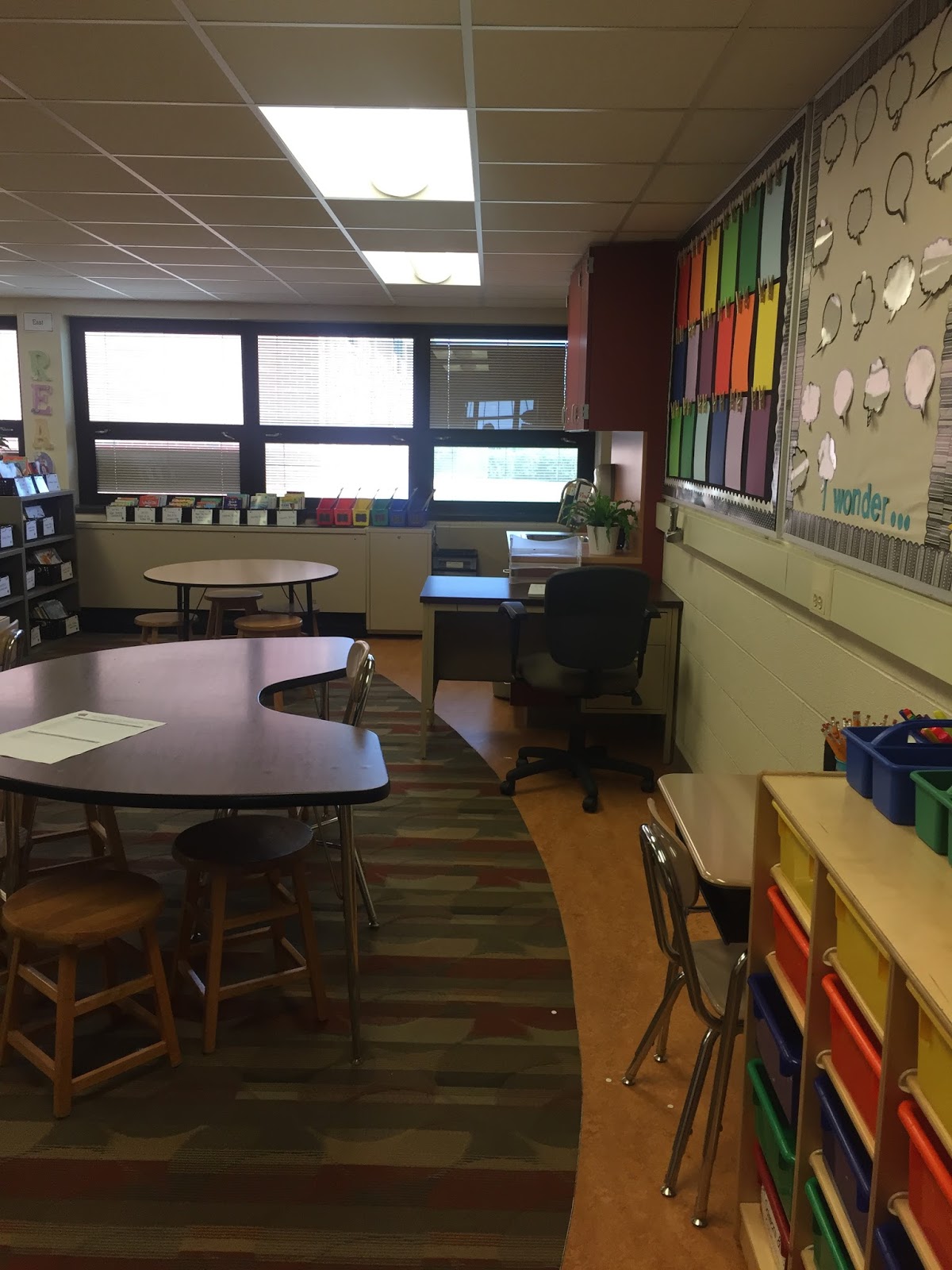
These are my two small group instructional spaces. I am lucky enough to have an assistant in my room for both my literacy studio block and my math workshop block. The two tables afford both of us space to work with students, either individually or in small groups. These tables also offer students other seating options during other times of the school day.


This is the fiction area of my library. I definitely need to work on beefing up my early chapter book collection over the course of this year. Thank goodness I've started stockpiling Scholastic Book Club bonus points! The nice part of having holes in my classroom library is that the kids can help me fill them by suggesting titles I should add to our collection.
Having this space all set got me in the right frame of mind for today. Though it was mostly spent in meetings, we did have Meet the Teacher for an hour where families could come check out our classroom and ME. I met all 18 of my terrific third graders. I shook each of their hands (we'll be working on that during Morning Meeting this week... believe me!) and introduced myself. They were so cute. And they were SO excited to see their desks, to see their lockers, to begin to explore our classroom. My favorite moment (besides the spontaneous hug I got from one departing youngster) was seeing so many of the kids flipping through the books, looking for old favorites and discussing new-to-them titles they'd like to read. It made my heart happy to see this labor of love getting the attention it so deserves. I couldn't have done it without the generosity of friends who donated books or who gifted me with Amazon gift cards so I could build the library my young learners need.
Today was important. Hard as it was to walk away from my friends who have supported me for the past 22 years, today showed me just how right I was to make this move. I needed to shake things up, to push myself outside my comfort zone, to get back in the company of children, to put myself back in the classroom to put to work the things I learned as a coach.
So that quote at the top of the page from another 23... That quote captures my thinking about my work this year. I will work hard. I will have high expectations for myself and my students. And my reward will be the knowledge that I'm where I am supposed to be, doing what I'm supposed to be doing.
Wednesday, July 20, 2016
Today I Crossed the Threshold
It's July 20, 2016. School starts in roughly a month and two days, but my brain has been spinning since the moment this spring when I decided to make the leap to third grade. If I'm being honest, I've spent a whole lot of time thinking about the things that are firmly in my comfort zone: classroom decor, my classroom library, my literacy studio. What I haven't thought about? Math. Science. Classroom procedures. Desk arrangements.
Today I was able to go into my new classroom for the first time. My boxes had been moved over from the Junior High (huge THANK YOU to the District 28 custodial staff for that), and I had a van full of more that I had at home. Walking through that door with my name on the sign was a surreal experience.
And this was my first thought:
This is what I looked at:
Right now I'm a bit overwhelmed at all I have to do in just four short weeks. But I also know from years of experience that it will get done. The bulletin boards will get covered and prepped to showcase student work. The desks will get arranged. The classroom library will get organized - or not... I'm considering letting the kids organize it. Maybe.
I also know that I can't do any real planning until that environment is set. Once I have that, I can begin envisioning the kids who will share my space and consider how we will go from twenty-something strangers to a community of learners who are willing to take risks on a daily basis. I will be ready to meet with my teammates and begin collaborating on lesson plans and unit plans that will engage and excite our third graders.
It's funny, even just writing all of this down is making me feel better. It's reminding me that I know what I have to do and that I always manage to get it done before my students arrive.
It's all good. Right?
Right?
Today I was able to go into my new classroom for the first time. My boxes had been moved over from the Junior High (huge THANK YOU to the District 28 custodial staff for that), and I had a van full of more that I had at home. Walking through that door with my name on the sign was a surreal experience.
And this was my first thought:
 |
| This is Chicago-in-July hair. I made three trips out to my van to carry everything in! :-) |
Right now I'm a bit overwhelmed at all I have to do in just four short weeks. But I also know from years of experience that it will get done. The bulletin boards will get covered and prepped to showcase student work. The desks will get arranged. The classroom library will get organized - or not... I'm considering letting the kids organize it. Maybe.
I also know that I can't do any real planning until that environment is set. Once I have that, I can begin envisioning the kids who will share my space and consider how we will go from twenty-something strangers to a community of learners who are willing to take risks on a daily basis. I will be ready to meet with my teammates and begin collaborating on lesson plans and unit plans that will engage and excite our third graders.
It's funny, even just writing all of this down is making me feel better. It's reminding me that I know what I have to do and that I always manage to get it done before my students arrive.
It's all good. Right?
Right?
Thursday, May 26, 2016
Onward to a New Adventure!

This year has been a difficult one - a year full of soul searching and deciding where I want to go in my career. I've spent 22 years teaching in a junior high; 18 years teaching seventh grade language arts and (part of the time) social studies and 4 years as a literacy coach. My work has been fulfilling, and I've always felt that seventh grade was the perfect grade for me. I loved the kids. I loved the books. I loved my school.
The four years I spent as a coach were also fulfilling, but in a different way. But more than that, I found coaching to be lonely and isolating. As the only instructional coach in my building, I missed the collaborative work I did with my grade-level job-alikes. I often felt like because I had a foot in teaching and a foot in the administrative side of the school, I wasn't part of either group. I decided this year that I needed to return to the classroom. I needed to be in the company of children.
So in the fall, I am moving schools within my school district. I will be teaching third grade at the elementary school my daughters attended. I am excited and a little bit terrified.
I'm excited to be part of a team again.
I'm excited to have my own classroom again.
I'm excited to only be responsible for my own teaching again.
I'm excited to be with children again.
I'm excited to plan units again.
I'm excited to be creative again.
I'm terrified of third graders.
I'm terrified of teaching math.
I'm terrified I won't know how to talk to third graders without making them cry.
I'm terrified of making new friends.
I'm terrified I won't remember how to teach.
I'm terrified I won't be a good teacher.
Those sibling feelings of terror and excitement are actually a good thing. They mean I care about the work I will be doing and the community I'll be a part of. I know I'll have teammates who will be there to help me and support me, and I'll be able to do the same for them. As a former literacy coach, I'll have tools in my toolbox that I didn't have before, and I have the benefit of having additional training in some of our district initiatives. I know I'll be fine.
Watch this space over the summer as I document my thinking about this big change. You'll see some reviews of professional books and sneak peeks of some of the things I'll be working on. I might just even float some ideas about classroom management and questions I have about the differences between third graders and middle schoolers.
It's going to be a wild ride, for sure.
Sunday, September 8, 2013
Talking It Out
One of my favorite quotes is by James Britton:
"Reading and writing float on a sea of talk."
One could go so far as to say "Learning floats on a sea of talk." 'Cause it does.
This is one of those things I wish I had realized early in my career. I would have been a much better teacher way-back-when if I would have remembered how much better I understood the content teachers were trying to teach when I was able to talk about it with others.
Case in point: My senior year of high school I decided to join the debate team. Many of my friends were debaters, and I knew they got to travel to tournaments on weekends, and it seemed like they were having a good time. I already had enough credits to graduate, so I thought why not? What I thought would be a fun class turned out to be one of the hardest classes I had in my entire four years of high school. The work load was tremendous. Not only did I have to do research with my partner to build our own affirmative case, we had to research rebuttal arguments to OTHER affirmative cases. The topic that year was American farm policy. I learned more about grain elevator accidents, factory farming, and other agricultural topics than I ever thought was possible. The thing that made me TRULY understand all of these topics, though, was TALKING about them in the course of the debates.
So why, then, as a young teacher, did I replicate most of my English classes, where students sat in rows, read the books that I told them to read, and answered questions that I already knew the answers to and expected them to read my mind?
Simple... I didn't know there was another way.
Fast forward about ten years and a whole lot of learning and reading. I began to realize that I wasn't filling my students with a love of reading and writing. If anything, I was teaching them that reading a novel was the equivalent of an eight-week-long worksheet.
I realized that I needed to capitalize on the adolescent need to SOCIALIZE to really engage students in my classes and cement their learning. More and more, we know that students need time to talk with each other to process their thoughts and work through new ideas. Talking with others provides the time and opportunity to hear other people's ideas, to ask questions, to reconsider and reformulate. When we give kids time to talk after they read a text and before they write, the writing they produce is more coherent, better developed, and goes to greater depth.
As a literacy coach, I am constantly talking about talk, working with teachers to show them the power of conversation, to help them notice the ratio of teacher talk to student talk in their classrooms.
Amazing things happen when classrooms are full of the buzz of purposeful talk.
Thursday, January 12, 2012
Time, continued
Yesterday I wrote a post over on the Illinois Writing Project blog about the power of conversation in learning. In it I discussed how I need to remember to give kids time to talk in order to enhance their learning in my class.
I continued to think about time today as I moved through my schedule. I've been making a concerted effort to give my students more time to read and write each week during our daily 80 minute language arts period. I want them to feel like they can take their time on assignments, not feel rushed to get through something so that they don't have homework at home. I've done enough reading of experts in literacy like Richard Allington to know that time to read (and write) in school is essential for growth, and most kids don't get nearly enough time to read over the course of the school day.
I also know I have a curriculum I am responsible for teaching.
It is easy to get caught up in the mad rush of checking individual skills off of that scope and sequence, to be able to say to the eighth grade teachers, "Yes, I taught that." The problem with cramming too much into each day is that, yes, I might be able to say, "I taught that," but I can't say with certainty, "The kids learned that." Wouldn't it be better to linger a bit in the most necessary areas so that I can be certain the kids truly learned what I'm trying to teach them? Can't less be more? Why can't I give myself permission to do this?
It's a matter of mindset. It's a matter of prioritizing. It's a matter of trusting myself as a professional to know my kids and their needs and to trust my ability to help them get where they need to be.
I continued to think about time today as I moved through my schedule. I've been making a concerted effort to give my students more time to read and write each week during our daily 80 minute language arts period. I want them to feel like they can take their time on assignments, not feel rushed to get through something so that they don't have homework at home. I've done enough reading of experts in literacy like Richard Allington to know that time to read (and write) in school is essential for growth, and most kids don't get nearly enough time to read over the course of the school day.
I also know I have a curriculum I am responsible for teaching.
It is easy to get caught up in the mad rush of checking individual skills off of that scope and sequence, to be able to say to the eighth grade teachers, "Yes, I taught that." The problem with cramming too much into each day is that, yes, I might be able to say, "I taught that," but I can't say with certainty, "The kids learned that." Wouldn't it be better to linger a bit in the most necessary areas so that I can be certain the kids truly learned what I'm trying to teach them? Can't less be more? Why can't I give myself permission to do this?
It's a matter of mindset. It's a matter of prioritizing. It's a matter of trusting myself as a professional to know my kids and their needs and to trust my ability to help them get where they need to be.
Sunday, September 11, 2011
My Favorite Conferences
 |
| A seventh grader in reading workshop |
Each year I start the school year with reading conferences. In these first conferences, my goals are to learn something about who each of my students is as a reader and to help them set a first quarter reading goal. In order to prepare for these conferences, I have students complete some sort of reading survey or interest inventory. Over the years, I have used a variety of surveys from a variety of places, but this year I used Nancie Atwell's September Reading Survey from the resource materials that came with her DVD Reading in the Middle. I really liked this particular survey, mostly for the way the questions were worded. It was fairly short, so it wasn't intimidating to the students, but it gave me the information I needed to find an entry point into my conferences.
This year I'm discovering that I have a group of great readers. Many of my students have read at least 4 books already in the first three weeks of class, and they are writing and talking about what they're reading. They can identify and discuss their strengths and weaknesses as readers, and have been coming up with great goals for first quarter. Many of my students have identified "Reading in a wider variety of genres" as a first quarter goal, which is fun for me as a teacher, because I get to booktalk many different kinds of books to help these students broaden their reading horizons.
I find I start with the reading conferences for one main reason: they're easier. They're easier for the kids, because I find kids are more confident in talking about who they are as readers (or non-readers) than who they are as writers. They're easier for me because as a voracious reader, there's nothing I like better than to talk to other readers about the books I love.
Eventually I'll have to start those writing conferences (hopefully this week!), and I have the September Writing Surveys all ready to go!
Friday, September 2, 2011
Whew!

So I had every intention of posting here during the first week of school, but as is often the case the first two weeks of school completely wiped me out. It was all I could do to drag myself home every afternoon and make dinner for my family.
I've had my afternoon nap, so I feel ready to reflect on what's happened so far.
Lessons these first few days have focused mostly on "here's how you do this" and getting to know my students as readers. The first day each of my classes talked about what has to happen in order to have a "good class." We made lists on chart paper and then compiled our class norms from those lists. Here's what my classes had to say:


As seventh graders, they've had many experiences in different types of classes, and the things that stood out to me as a result of our conversations are that kids really want teachers who listen to them and treat them with respect. The kids in my classes also wanted to be challenged but at the same time have fun. I have a feeling that these three classes are going to quickly grow into supportive learning community, something that is important for my classroom to run the way I envision.
Every year, part of me feels like I should jump in from day one with the business of my content. The part of me that respects the workshop process knows that spending the time building these relationships and routines will pay off later. I am honoring the time it will take to build these groups.
The most exciting thing so far is the sheer number of library books students have checked out of my classroom library. The books are flying off of my book displays, and I actually have empty baskets, something that has rarely happened in the past. I have waiting lists for the three Hunger Games titles, Divergent, and Darth Paper Strikes Back. The kids are talking to each other about the books they love and selling these books even better than I could. During my "getting to know you" reading conferences, they are eager to talk about genres and authors they love and have definite ideas about first quarter reading goals. I'm hoping the same thing happens next week as we begin to talk more about students as writers.
September is a rosy time in my reading-writing workshop. The kids and I are in a sort of a honeymoon period, and I know that soon I will get push-back from some of my more reluctant or tangled readers, but I'm hoping by that time I will know them well enough to support them and start where they're at and help them grow.
Like I told the parents at open house last night, I feel I have the best job in the world. I get to go to work every day and talk to great kids about reading and writing. What could be better?
Thursday, August 18, 2011
As Ready As I'm Gonna Be

(This photo is the view from my doorway. The room is much smaller than it appears in this photo.)

(This is the view of the front of the room from my desk.)

I've written lesson plans for the first two weeks of school, focusing on launching my reading & writing workshops, and I've sent my picture of my summer reading book stack to our media specialist to make into an ALA style READ poster. I've made my copies. I've weeded and rearranged my library.
(This is our meeting area/reading corner. I used to have sofas, but they got really smelly in my "garden level" classroom.)

Now I wait and wonder. I wonder about my new kids - what will they be like? Will they be readers like my last two groups; kids who devour books as quickly as I do? Will they see themselves as writers and embrace the genres we will study? Will they gel into a community where risk-taking is appreciated and undertaken?
(Most of my classroom library--arranged by genre)

(The back corner where my desk sits. I haven't had the urge to get rid of it yet!)

One of the best parts of my job is that I get a fresh start every August. Each school year I have the chance to be a better teacher than I was the year before. I love the challenges that come with the territory of teaching young adolescents, and I love the laughter they carry with them through my classroom door (pictured, left).
So bring it on! I'm ready (I think).
Monday, August 15, 2011
Welcome to the Inaugural Post of Making It Work in the Middle!
School starts just one week from today, and I finally feel like I'm ready to start tackling planning. Last year was a difficult one for me, both professionally and personally, and I'm looking forward to a better year this year!
One of the ways I am setting myself up for success is through this blog. I'm hoping to post here on a regular basis as a way to process my thinking and learning this year. One would think that after 17 years of teaching seventh grade language arts I would have it all figured out. Not quite! What I discover, year after year, is that the more I know the more I realize I have left to learn. I am lucky to work in a school district that values professional learning, and as such I have access to amazing mentors such as Ellin Keene and Diane Sweeney. Just as important are the mentors I have sought out for myself, people such as Donalyn Miller, Teri Lesesne, Jim Burke, Kelly Gallagher, Patrick Allen, and the many other teachers who are part of my online professional learning network. Each of them challenges my thinking every day.
One of the books I'm reading right now is Day by Day by Ruth Ayres and Stacey Shubitz (Stenhouse, 2011). Ayres and Shubitz have formatted this book in such a way that it compels the reader to reflect on her practice and strive to become better. Right now, I'm still on chapter 1, "Routines." As I've begun my planning for the first few weeks of school, I've thought about the routines that help to make my reading and writing workshops run smoothly. I know that establishing and practicing these routines is essential to the success of my workshops, but sometimes I get bogged down in the day-to-day minutia of my class that I forget to practice them with my students! If anyone else out there is working through Day by Day, I'd love to have someone to share my thinking with!
One of the ways I am setting myself up for success is through this blog. I'm hoping to post here on a regular basis as a way to process my thinking and learning this year. One would think that after 17 years of teaching seventh grade language arts I would have it all figured out. Not quite! What I discover, year after year, is that the more I know the more I realize I have left to learn. I am lucky to work in a school district that values professional learning, and as such I have access to amazing mentors such as Ellin Keene and Diane Sweeney. Just as important are the mentors I have sought out for myself, people such as Donalyn Miller, Teri Lesesne, Jim Burke, Kelly Gallagher, Patrick Allen, and the many other teachers who are part of my online professional learning network. Each of them challenges my thinking every day.
One of the books I'm reading right now is Day by Day by Ruth Ayres and Stacey Shubitz (Stenhouse, 2011). Ayres and Shubitz have formatted this book in such a way that it compels the reader to reflect on her practice and strive to become better. Right now, I'm still on chapter 1, "Routines." As I've begun my planning for the first few weeks of school, I've thought about the routines that help to make my reading and writing workshops run smoothly. I know that establishing and practicing these routines is essential to the success of my workshops, but sometimes I get bogged down in the day-to-day minutia of my class that I forget to practice them with my students! If anyone else out there is working through Day by Day, I'd love to have someone to share my thinking with!
Subscribe to:
Posts (Atom)