Showing posts with label reading. Show all posts

Monday, August 14, 2017

The Decisions Series: Part 1 - My Classroom Library

I spend a lot of time thinking about my classroom library. For me, this is the heart of my classroom. Community is made here. Thinking happens here. Eyes and hearts are opened here. Kids find themselves and the world here.

I've invested a great deal of effort and money in curating my classroom library. I'm careful about the books I add, but I also buy books my students request. This means that there are books that I might not choose to read but that THEY love. That is as it should be... it is their library, too, and I want to make sure they feel ownership of it just as I do.


The biggest decision I've made about my classroom is how to organize it. Way back in the dark ages when I first started teaching 7th grade ELA, I had all of my classroom library books spine out  and alphabetized by author's last name.  It was fine.  Some kids used my library, but they mostly checked books out from the school library or only read the whole-class novels that formed the base of our curriculum.  Like I said... it was fine.  But I always thought it could be MORE.

When our school district started working with Ellin Oliver Keene in order to strengthen our literacy instruction, I had the opportunity to spend time in several classrooms in our elementary buildings.  I noticed some things about the libraries in those rooms.  Books were all face-out.  They were in baskets. And they were sorted by genre, series, or author.  I began to think about what would happen if I reorganized the library in my seventh grade classroom.  I wondered how long it would take me to sort, label, and store the hundreds of books I had on my shelves.  I decided to let the kids help.

To be honest, it was a mess for several days.  But then.... then it was GLORIOUS!  Kids knew what was on the shelves!  They found books they wanted to read!  They began using the library!

So when I moved to third grade last year, the answer to the organization question was a no-brainer.  Face out. Sorted by genre, series, author. Informational texts in their own section. User friendly for the kids and for me. This is important, because in my room kids get to choose all of the books they read during Literacy Studio.  They are not required to read in a certain level or for Accelerator Reader points (thank goodness!).  I won't tell them a book is too easy or too hard.  I will talk to them about who they are as readers and what they can do to grow.  This choice in reading is a non-negotiable.

My greatest wish is that when the kids come into my room next Monday for Meet the Teacher, they won't spend much time talking to or looking at me.  I want them pulled like magnets to my library.  I want them to flip through the books.  I want them to ask me if they can put a particular book on their desks so they can read it on Tuesday.  I want them to find some old friends and maybe make some new ones as they look to see what's in all of those black baskets.

I want them to love our library as much as I do.


Saturday, June 10, 2017

Recommended Reading from Room 301

The school year just ended and I have some things I need to write about, but I'm still processing the school year that was.  For today, I've decided to share the titles my third graders have designated as "must reads." Here for you, in no particular order, are their favorite books from this year.  If they are books I've written about over at NextBestBook, I've included the link.


  • Fake Mustache by Tom Angleberger
  • Cody and the Mysteries of the Universe  and Cody and the Fountain of Happiness by Tricia Spring Stubb
  • The Nancy Drew books by Carolyn Keene
  • I Could Not Keep Silent: The Life of Rachel Carson by Clare Meeker
  • The Truth About Twinkie Pie by Kat Yeh
  • Honey by Sarah Weeks
  • Mr. Pants by Scott McCormick
  • Upside Down Magic by E. Lockhart, Lauren Myracle, and Sarah Mlynowski
  • Book Scavengers by Jennifer Chambliss Bertman
  • Firefly Hollow by Alison McGhee
  • Close to Famous by Joan Bauer
  • One for the Murphys by Lynda Mulally Hunt
  • The Baby Sitters Club graphic novels by Raina Telemeier
  • The Amulet series by Kazu Kibuishi
  • The Percy Jackson series by Rick Riordan
  • The Great Book Eating Boy by Oliver Jeffers
  • Adventure According to Humphrey by Betty G. Birney
  • Pie by Sarah Weeks
  • Jack  by Liesl Shurtlif
  • The Day the Crayons Quit and The Day the Crayons Came Home by Drew Daywalt
  • The Kindness Club  by Courtney Sheinmel
  • Wish by Barbara O'Connor
  • Gabby & Gator by James Burks
  • Lady Pancake & Sir French Toast and The Case of the Stinky Stench by Josh Funk
  • Dog Man by Dav Pilkey
  • Amina's Voice by Hena Khan
  • Moo by Sharon Creech
  • A Snicker of Magic by Natalie Lloyd
  • The Harry Potter series by JK Rowling
  • The Diary of a Wimpy Kid series by Jeff Kinney
  • Like Pickle Juice on a Cookie by Julie Steinberg
  • Save Me a Seat by Sarah Weeks
  • The Dork Diaries by Renee Russel
  • Drita, My Homegirl by Jenny Lombard
  • How to Speak Dolphin by Ginny Rorby
  • The Anna,Banana series by Anica Mrose Rissi
  • When I Grow Up: Misty Copeland by Lexi Ryles
  • When I Grow Up: Sonya Sotomayor by AnnMarie Anderson
  • Swindle by Gordon Korman
  • Charlotte's Web by EB White
  • We Are All Wonders by RJ Palacio
  • Wonder by RJ Palacio
  • Auggie & Me by RJ Palacio
  • I Want My Hat Back and This Is Not My Hat by Jon Klassen
  • 11 Birthdays, 12 Finally, 13 Gifts, and The Last Present by Wendy Mass
  • Graceful  by Wendy Mass
  • A Mango Shaped Space by Wendy Mass
  • Jeremy Fink and the Meaning of Life by Wendy Mass
  • The Candymakers and The Candymakers and the Chocolate Chase by Wendy Mass
  • The Happily Ever After series by Wendy Mass
  • Fish in a Tree by Linda Mulally Hunt

Thursday, April 6, 2017

Post PARCC Poetry

This week, my third graders are taking the PARCC test for the first time.  So far, we've taken three of the four 1-hour mathematics tests, and they seem to be handling it very well.  In prepping them to take this test, I talked with them about how their parents and I want them to do their best, but at the same time, their lives to not hinge on the results.  I don't believe in getting kids all worked up and anxious about their performance on standardized tests, especially in third grade.

As I was doing my lesson planning for this week, I thought about how I wanted the kids to feel at the end of the day.  Because the math tests were taking an hour of my literacy block, I decided to steal that time back during my scheduled math time so the kids could have more than 30 minutes to read or write.  We're in the tail end of our study of myths and legends, so I knew they would be planning and writing their legends.  April is also National Poetry Month, so I wanted to work in some poems as well.

I made the decision to take that hour after lunch to read and discuss a poem or a poetry picture book and then invite the kids to try out whatever poetic device or poetic form featured.  So far, we've read Dogku by Andrew Clements, some recipe poems I found online, Forest Has a Song by Amy Ludwig VanDerWater, and Falling Down the Page by Georgia Heard.  Each day, the energy and buzz in the classroom during our literacy studio have been amazing.  The kids are trying out their poetry writing without hesitation.  I see them taking risks and playing with words and rhyme and meter, reading their writing out loud to each other to see how the poems sound.  They are playing with poetry.
Students experiment with color poems inspired by Amy Ludwig VanDerWater's Writing the Rainbow Challenge
I made a conscious decision NOT to do formal lessons on meter, rhyme, figurative language, and poetic forms.  I wanted this exploration of the possibilities of poetry to be playful and low-stakes.  I wanted this hour to be the complete opposite of the hour of PARCC testing the kids experienced in the morning, where they had to be silent and still.

There has been no silence in my literacy studio this week.  There has been no stillness.

And I am TOTALLY fine with that!

Monday, February 27, 2017

In a slump

Age 3. Reading. Of course.

I have been a reader for as long as I can remember.  Not a casual, "Oh, I'll read for a bit to pass the time" kind of reader.  I'm a "Life is not worth living if I don't have a book with me" kind of reader.  Last year alone, I read 359 books.  I don't say that to brag, but rather to let you know that I am a reader. An avid one.

Over the course of my reading life, I've gone through cycles.  I'll binge on trashy romances and then make it up to myself by reading something literary.  I read more young adult books than I could possibly count when I was teaching seventh grade ELA.  Now, my reading rate is much higher because I'm reading mostly picture books and early chapter books.

Or at least I was.

About age 12. Reading. Of course.

Because right now, I'm not reading much of anything.  Since returning to school after winter break, I have not been able to find a book that will hold my attention.  I've tried just about every type of book I can think of to get myself back on track.  I've started books I've heard about on NPR, ones that I read about in People magazine.  Books recommended by friends, books I bought  from the Scholastic flyer.  Books for adults.  Books for kids.  Books for teens.

Have I found that book that will give me my reading mojo back yet?  Nope.  And to be honest, I'm kind of concerned about that.  I think this is the longest I've ever gone without finishing a book, at least since high school.  Maybe it's that I'm preoccupied by life right now, and my focus is elsewhere.  Perhaps I'm too distracted by Facebook and Twitter to focus on a longer text.

Age 48. Reading Kind of.
Or maybe I just need some time and space to lose myself in words again.  Spring break is just four weeks away, and as of right now, that week is wide open.  Dan will be at work.  Molly will be out of town with the orchestra.  Abby will be with friends or making art in her room.  That leaves a whole week of quiet for just me and the dog and a stack of books.

Now... how do I figure out what I'll read first?


Monday, January 30, 2017

Lightbulb Moments

Some days, after I've walked my third graders out the front door of the school, I go back to my classroom and just sit at my desk.  It often looks as if a tornado has hit it, since I don't have time to put things away over the course of the day.  I turn my chair so that I'm facing the groups of student desks and I think about the day just past.

I'm not always happy about that reflection.  Some days, it seems like I'll model, and think aloud, and provide practice, and confer, and provide feedback and the kids just don't seem to GET IT.  It's as if we're in a third-grade version of Groundhog Day and I'm Bill Murray, making small adjustments to my instruction, thinking that I've finally made a difference, then WHAM!  That clock flips and Sonny & Cher come on and I'm right back where I was the day before.

Some days, I just want to throw in the towel and give up and move on.

That is a rather hyperbolic description of the weeks since winter break. My literacy coach and I had been working with the students on using text evidence to answer questions in the reading part of our literacy studio and the beginnings of writing opinion papers in the writing part.  We were doing all of the things we were supposed to be doing (see list above).  To be truthful, we did see small movement in the students' ability to answer "right there" questions and to write very basic paragraphs, but it was slow going.

And then it wasn't!  Last Thursday, it was like a switch flipped and things started to click.  I had given students a short piece of text entitled "Should Students Learn Cursive" that we read together and discussed.  As third graders, this is a topic they are interested in, as many of them learned to write their names in cursive in second grade, and they want to learn more.  For their opinion writing practice, I asked them to take a side... should they have to learn cursive in schools?  Why?  Why not?
They started writing like they were on fire!  I saw T-charts and webs and bullet lists being created in the planning space.  I saw them going back into the text to reference the pro and con arguments.  I had students asking me for writing advice.  I had students asking EACH OTHER for writing advice (even better).  I saw students writing multi-paragraph papers outlining all the reasons they SHOULD learn to write (and read) cursive.  I nearly fell off of my conferring stool!

It was a lightbulb moment day.  Teachers live for those.

But it was also a day that reminded me that learning takes time.  I have to avoid getting caught up on where I think I'm "supposed" to be on a timeline or a curriculum map, and I have to honor the students who make up our learning community.  I have to think about where they are at on that day, and what they need NEXT to grow as writers.  Most important, I need to remember to teach the WRITER not the writing.

These are not new lessons for me.  But the reminder is no less important.  If I were not reflective about my practice; if the literacy coach had not reminded me to step back and be an observer in my own classroom, I might have just moved on to the next stop on the curriculum train.  I know in my heart that when I take the time my students need, I am doing the right thing - no matter what the calendar says.

So tomorrow, I'll head back into Room 301, and I'll model and think aloud and confer and listen and give feedback.  But I'll also observe and think.

And I'll watch for the lightbulbs.

Wednesday, December 14, 2016

From My Stacks #1

Last week, my friend Patrick Allen wrote about three books he rediscovered in his classroom library.  He shared how he might use them with students in his reading workshop.  After reading his post, I was inspired to take a virtual walk through my classroom library in order to do a similar post.

My library is new.  When I made the decision to move from middle school to third grade, I had to get rid of my YA library (most of which was donated to a group who will get the books into other classroom libraries) and build one appropriate for third graders.  I had a LOT of help.  Friends donated books to the cause.  Others sent me Amazon gift cards to use to purchase books.  The Scholastic Warehouse Sale was a gold mine.  The work was worth it.  The kids are loving the books, which was the goal all along.

Today's edition of From My Stacks will focus on three books that elicited great thinking and discussion among my third graders.

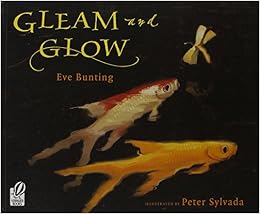
1.  Gleam and Glow by Eve Bunting

Gleam and Glow tells the story of a family forced to leave their home as a result of war.  As the family prepares to flee before the army arrives in their town, the children wonder what will become of the goldfish they've promised to care for.  Eventually, they must leave, and with no other choice, put the goldfish in the pond near their house.  Though this is a story about the war in Bosnia, it has clear connections to the wars happening in the middle east today.

I used this book when showing my students how readers listen to their "inner voices".  My assistant read the story out loud while I modeled being the inner voice (I even held a thought bubble around my head as you can see in the photo), talking about my thinking as the story went on.

When we discussed the story, the kids really wanted to talk about the family and how they had to flee their home and everything they loved.  They were moved by the hardship the mother and the two kids went through as they tried to get to safety and to find their father.  Few of the students knew about the refugees fleeing Syria and we were able to have an age-appropriate conversation about humanity, compassion, and love.  This lesson turned out to be about way more than reading comprehension.


2.  Miss Paul and the President by Dean Robbins

In the lead-up to this year's election, I just couldn't bring the nastiness of the campaign into a classroom where the number one expectation is to treat others the way you want to be treated.  Instead, I chose to focus on the importance of participating in the process.  As a class, we had several discussions on why it is important to cast a ballot, not just in presidential elections, but also in local elections such as those for school board and city council. One of the books I shared was Miss Paul and the President by Dean Robbins.  A picture book biography of Alice Paul, this book shows kids the struggle involved in getting women the right to vote.  Many of my students were surprised to learn that women have been able to vote in federal elections for less than 100 years, and this book became a jumping off point to talk about why women felt they needed a voice in elections and why a vote is important.  The students were very curious about the tactics the National Woman's Party used to convince the people of America, a great deal of whom did not feel women were capable of the complexity of thought to cast a ballot, to ratify the Nineteenth Amendment.

The kids' questions and comments were thoughtful and thought provoking.  They ranged from disbelief that people used to think women were incapable of voting or pursuing a profession such as medicine or law to curiosity over whether or not a single vote matters so much.  I will definitely use this book again, even in a non-election year.

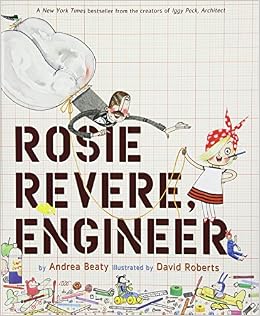
3.  Rosie Revere, Engineer by Andrea Beatty

Since the first day of school, I've been working on growth vs. fixed mindset.  It's surprising to me (though it probably shouldn't be) how many of my students come in to third grade believing that they are not good at math or who give up the minute something becomes challenging. When I read Rosie Revere, Engineer as well as the companion books Iggy Peck, Architect and Ada Twist, Scientist, we were able to talk about how the characters responded to the challenges they faced and how the characters didn't give up.  I also love that these books include girls doing traditionally "boy" activities like inventing and doing scientific experiments.
At first, my students responded to the whimsical illustrations by David Roberts, but they were quickly drawn into the story.  They were appalled when Rosie's uncle laughed at her invention, and cheered when Rosie's invention succeeded - if only for a while.  The kids were eager to talk about what Rosie (and Iggy and Ada) learned over the course of the story, and long after the last page turned, these characters continue to come up in classroom discussions.

I have so many more books that my kids have loved.  I have even more that I am excited to share.  My students know that if there is ONE thing I am passionate about, it is books.  They know that most weeks I have at least one or two new books to add to our classroom collection, and that as soon as I get them catalogued and numbered they are free to read them as often as they wish.  I know that my excitement about books NEW and OLD is contagious!

Watch for my next "From my Stacks" edition in January!

Friday, September 2, 2011

Whew!


So I had every intention of posting here during the first week of school, but as is often the case the first two weeks of school completely wiped me out.  It was all I could do to drag myself home every afternoon and make dinner for my family.

I've had my afternoon nap, so I feel ready to reflect on what's happened so far.

Lessons these first few days have focused mostly on "here's how you do this" and getting to know my students as readers.  The first day each of my classes talked about what has to happen in order to have a "good class."  We made lists on chart paper and then compiled our class norms from those lists.  Here's what my classes had to say:
 

As seventh graders, they've had many experiences in different types of classes, and the things that stood out to me as a result of our conversations are that kids really want teachers who listen to them and treat them with respect.  The kids in my classes also wanted to be challenged but at the same time have fun.  I have a feeling that these three classes are going to quickly grow into supportive learning community, something that is important for my classroom to run the way I envision.

Every year, part of me feels like I should jump in from day one with the business of my content.  The part of me that respects the workshop process knows that spending the time building these relationships and routines will pay off later.  I am honoring the time it will take to build these groups.

The most exciting thing so far is the sheer number of library books students have checked out of my classroom library.  The books are flying off of my book displays, and I actually have empty baskets, something that has rarely happened in the past.  I have waiting lists for the three Hunger Games titles, Divergent, and Darth Paper Strikes Back.  The kids are talking to each other about the books they love and selling these books even better than I could.  During my "getting to know you" reading conferences, they are eager to talk about genres and authors they love and have definite ideas about first quarter reading goals.  I'm hoping the same thing happens next week as we begin to talk more about students as writers.

September is a rosy time in my reading-writing workshop.  The kids and I are in a sort of a honeymoon period, and I know that soon I will get push-back from some of my more reluctant or tangled readers, but I'm hoping by that time I will know them well enough to support them and start where they're at and help them grow.

Like I told the parents at open house last night, I feel I have the best job in the world.  I get to go to work every day and talk to great kids about reading and writing.  What could be better?