Showing posts with label education. Show all posts

Wednesday, December 14, 2016

From My Stacks #1

Last week, my friend Patrick Allen wrote about three books he rediscovered in his classroom library.  He shared how he might use them with students in his reading workshop.  After reading his post, I was inspired to take a virtual walk through my classroom library in order to do a similar post.

My library is new.  When I made the decision to move from middle school to third grade, I had to get rid of my YA library (most of which was donated to a group who will get the books into other classroom libraries) and build one appropriate for third graders.  I had a LOT of help.  Friends donated books to the cause.  Others sent me Amazon gift cards to use to purchase books.  The Scholastic Warehouse Sale was a gold mine.  The work was worth it.  The kids are loving the books, which was the goal all along.

Today's edition of From My Stacks will focus on three books that elicited great thinking and discussion among my third graders.

1.  Gleam and Glow by Eve Bunting

Gleam and Glow tells the story of a family forced to leave their home as a result of war.  As the family prepares to flee before the army arrives in their town, the children wonder what will become of the goldfish they've promised to care for.  Eventually, they must leave, and with no other choice, put the goldfish in the pond near their house.  Though this is a story about the war in Bosnia, it has clear connections to the wars happening in the middle east today.

I used this book when showing my students how readers listen to their "inner voices".  My assistant read the story out loud while I modeled being the inner voice (I even held a thought bubble around my head as you can see in the photo), talking about my thinking as the story went on.

When we discussed the story, the kids really wanted to talk about the family and how they had to flee their home and everything they loved.  They were moved by the hardship the mother and the two kids went through as they tried to get to safety and to find their father.  Few of the students knew about the refugees fleeing Syria and we were able to have an age-appropriate conversation about humanity, compassion, and love.  This lesson turned out to be about way more than reading comprehension.


2.  Miss Paul and the President by Dean Robbins

In the lead-up to this year's election, I just couldn't bring the nastiness of the campaign into a classroom where the number one expectation is to treat others the way you want to be treated.  Instead, I chose to focus on the importance of participating in the process.  As a class, we had several discussions on why it is important to cast a ballot, not just in presidential elections, but also in local elections such as those for school board and city council. One of the books I shared was Miss Paul and the President by Dean Robbins.  A picture book biography of Alice Paul, this book shows kids the struggle involved in getting women the right to vote.  Many of my students were surprised to learn that women have been able to vote in federal elections for less than 100 years, and this book became a jumping off point to talk about why women felt they needed a voice in elections and why a vote is important.  The students were very curious about the tactics the National Woman's Party used to convince the people of America, a great deal of whom did not feel women were capable of the complexity of thought to cast a ballot, to ratify the Nineteenth Amendment.

The kids' questions and comments were thoughtful and thought provoking.  They ranged from disbelief that people used to think women were incapable of voting or pursuing a profession such as medicine or law to curiosity over whether or not a single vote matters so much.  I will definitely use this book again, even in a non-election year.

3.  Rosie Revere, Engineer by Andrea Beatty
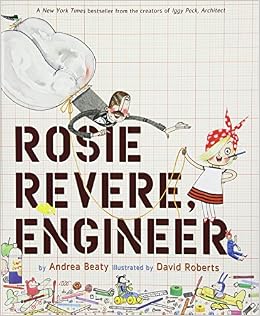
Since the first day of school, I've been working on growth vs. fixed mindset.  It's surprising to me (though it probably shouldn't be) how many of my students come in to third grade believing that they are not good at math or who give up the minute something becomes challenging. When I read Rosie Revere, Engineer as well as the companion books Iggy Peck, Architect and Ada Twist, Scientist, we were able to talk about how the characters responded to the challenges they faced and how the characters didn't give up.  I also love that these books include girls doing traditionally "boy" activities like inventing and doing scientific experiments.
At first, my students responded to the whimsical illustrations by David Roberts, but they were quickly drawn into the story.  They were appalled when Rosie's uncle laughed at her invention, and cheered when Rosie's invention succeeded - if only for a while.  The kids were eager to talk about what Rosie (and Iggy and Ada) learned over the course of the story, and long after the last page turned, these characters continue to come up in classroom discussions.

I have so many more books that my kids have loved.  I have even more that I am excited to share.  My students know that if there is ONE thing I am passionate about, it is books.  They know that most weeks I have at least one or two new books to add to our classroom collection, and that as soon as I get them catalogued and numbered they are free to read them as often as they wish.  I know that my excitement about books NEW and OLD is contagious!

Watch for my next "From my Stacks" edition in January!

Monday, December 5, 2016

I Control the Weather

“I’ve come to a frightening conclusion that I am the decisive element in the classroom. It’s my personal approach that creates the climate. It’s my daily mood that makes the weather. As a teacher, I possess a tremendous power to make a child’s life miserable or joyous. I can be a tool of torture or an instrument of inspiration. I can humiliate or heal. In all situations, it is my response that decides whether a crisis will be escalated or de-escalated and a child humanized or dehumanized.” - Haim G. Ginott

After four years as a literacy coach, there are some things I'm relearning in my return to the classroom.  This is one of those things.  As teachers, it's easy to get caught up in all of the "stuff" that we need to do that may or may not be part of our work in our classrooms with our kids:  attending meetings, reading (both books for kids and books for ourselves), doing report cards, filling out paperwork, reading and answering emails... the list feels endless.

And in December, the stuff feels compounded because we know we have things that MUST be finished before we leave for our two week winter break.

And on top of that, kids come back from Thanksgiving week acting as if they've never heard our classroom expectations, meaning we have to take about ten steps back and reintroduce classroom rules and routines.

One day last week, a girl in my class asked if I needed to borrow her stress ball.

This was a HUGE sign to me that I needed to step out into the hallway, take a deep breath, and re-connect with my vision of my dream classroom.  I needed to clear away the fog, blow away the storm clouds, and let the sunshine break through.  Last week was a clear indicator to me that the kids follow my lead.  Of course they were out of sorts, trying to figure their way through a busy week - their teacher was doing the same.  I was indeed stressed out, thinking of all of the tasks that had yet to be ticked off my list and worrying about what would happen if I didn't get them all done.  Over the weekend, I made some promises to myself and to my students (though they don't know it):

  • I will take time each day, even if it's just twenty minutes, to do something just for me.  Self-care is often the very last line item on my to-do list, and I can tell when I don't take care of my mental and physical well-being;
  • I will PRIORITIZE my to-do lists and work hard to make my daily list realistic.  Just because there are 57 things I need to do over the course of a week, there's no reason to list all 57 every day.  I'm the kind of person who gets overwhelmed when I have too many things to do and I become paralyzed.  There's a fine line between organized and overwhelmed;
  • I will breathe.  I know that sounds a bit dismissive, but I do forget to slow down and take deep breaths.  It's almost as if my shoulders have strings attached to them, and over the course of the day someone pulls those strings to that my shoulders end up around my ears.  When I breathe, I relax and feel more like myself;
  • I will SLOW DOWN and focus on the young learners in front of me.  They, after all, are the reason I'm there.  They'll only be in third grade once, and they're counting on me to do my best to help them learn.  When I'm focused on those eighteen young people, I can't help but smile and laugh.  And laughter is catching.

So I'll make it through the next two and a half weeks.  We'll make it through.  And we'll enjoy the weather along the way.

Thursday, May 26, 2016

Onward to a New Adventure!


This year has been a difficult one - a year full of soul searching and deciding where I want to go in my career.  I've spent 22 years teaching in a junior high; 18 years teaching seventh grade language arts and (part of the time) social studies and 4 years as a literacy coach.  My work has been fulfilling, and I've always felt that seventh grade was the perfect grade for me.  I loved the kids.  I loved the books.  I loved my school.

The four years I spent as a coach were also fulfilling, but in a different way.  But more than that, I found coaching to be lonely and isolating.  As the only instructional coach in my building, I missed the collaborative work I did with my grade-level job-alikes.  I often felt like because I had a foot in teaching and a foot in the administrative side of the school, I wasn't part of either group.  I decided this year that I needed to return to the classroom.  I needed to be in the company of children.

So in the fall, I am moving schools within my school district.  I will be teaching third grade at the elementary school my daughters attended.  I am excited and a little bit terrified.

I'm excited to be part of a team again.
I'm excited to have my own classroom again.
I'm excited to only be responsible for my own teaching again.
I'm excited to be with children again.
I'm excited to plan units again.
I'm excited to be creative again.

I'm terrified of third graders.
I'm terrified of teaching math.
I'm terrified I won't know how to talk to third graders without making them cry.
I'm terrified of making new friends.
I'm terrified I won't remember how to teach.
I'm terrified I won't be a good teacher.

Those sibling feelings of terror and excitement are actually a good thing.  They mean I care about the work I will be doing and the community I'll be a part of.  I know I'll have teammates who will be there to help me and support me, and I'll be able to do the same for them.  As a former literacy coach, I'll have tools in my toolbox that I didn't have before, and I have the benefit of having additional training in some of our district initiatives.  I know I'll be fine.

Watch this space over the summer as I document my thinking about this big change.  You'll see some reviews of professional books and sneak peeks of some of the things I'll be working on.  I might just even float some ideas about classroom management and questions I have about the differences between third graders and middle schoolers.

It's going to be a wild ride, for sure.

Tuesday, October 6, 2015

A Little Cognitive Dissonance Can Be a Good Thing

Last week, I had the pleasure of hosting Cris Tovani for a PD day at my school.  She spent the morning meeting with our seventh and eighth grade teams, discussing ways to engage and motivate students.  In the afternoon, she met with our building literacy coaches, and we talked about ways to engage and motivate the teachers we work with in the PD we offer, not just coaching cycles, but also book studies and workshops.

One of the things I do for myself as a professional, something I have always found to be an essential part of my professional life, is to participate in professional development opportunities with an attitude of "I will learn as much as I can."  This session with Cris was no different.

We talked about the PD opportunities we provide for teachers.  We talked about how many of the teachers in our buildings take advantage of those opportunities. We talked about the cultures of the buildings in terms of teachers being learners as well.  We talked about whether or not it is ok for teachers to "opt out" of professional learning.

In one of our buildings, every core academic teacher is expected to engage in coaching, either individually or with their grade level teams.  I knew this was the expectation in this particular building, as we've talked in our coaching team about the different ways this coach makes this happen. Thinking about implementing this in my building makes my head hurt.  I am one person.  I don't know how I would physically coach roughly 40 people every year.

Cognitive dissonance.

This doesn't mean I shouldn't think about possibilities.  This doesn't mean I shouldn't consider whether or not this approach is the right one for my building.  This doesn't mean I shouldn't engage in conversation around this topic with my principal.

Cris also suggested that the learning targets our teachers use to communicate goals and expectations to students would improve the effectiveness of our PD sessions and coaching cycles.  That engaging teachers in conversation around possible targets for their coaching might increase motivation and engagement in coaching.

Cognitive dissonance.

Why wouldn't I use a technique used across the building with students, one that I've seen to be highly effective in keeping teachers focused on keeping mini-lessons short and to the point, in my coaching?  It is just as important that I keep my observations and coaching conversations to the point.

Cognitive dissonance can be uncomfortable.  It makes my brain hurt.  It makes me wonder if I really know what I'm doing at ALL.  When I am feeling this, I KNOW this means my brain is working to take in new information and fit it in to what I already know.  I KNOW that when I give myself time to process (preferably verbally with others), I can make sense of the tough questions I've been asked, and I can incorporate new ideas into my work, which ultimately makes me a better teacher and coach.

Writing this makes me wonder if I am asking the teachers I coach the questions that will provoke cognitive dissonance.  I wonder if I am offering PD workshops and book studies that will push teachers to consider their practice in new and different ways.

Am I providing opportunities that will lead to real growth?  I think this will be the big question I pursue as I reflect on my work this year.

Thursday, January 12, 2012

Time, continued

Yesterday I wrote a post over on the Illinois Writing Project blog about the power of conversation in learning.  In it I discussed how I need to remember to give kids time to talk in order to enhance their learning in my class.

I continued to think about time today as I moved through my schedule.  I've been making a concerted effort to give my students more time to read and write each week during our daily 80 minute language arts period.  I want them to feel like they can take their time on assignments, not feel rushed to get through something so that they don't have homework at home.  I've done enough reading of experts in literacy like Richard Allington to know that time to read (and write) in school is essential for growth, and most kids don't get nearly enough time to read over the course of the school day.

I also know I have a curriculum I am responsible for teaching.

It is easy to get caught up in the mad rush of checking individual skills off of that scope and sequence, to be able to say to the eighth grade teachers, "Yes, I taught that."  The problem with cramming too much into each day is that, yes, I might be able to say, "I taught that," but I can't say with certainty, "The kids learned that."  Wouldn't it be better to linger a bit in the most necessary areas so that I can be certain the kids truly learned what I'm trying to teach them?  Can't less be more? Why can't I give myself permission to do this?

It's a matter of mindset.  It's a matter of prioritizing.  It's a matter of trusting myself as a professional to know my kids and their needs and to trust my ability to help them get where they need to be.

Friday, September 2, 2011

Whew!


So I had every intention of posting here during the first week of school, but as is often the case the first two weeks of school completely wiped me out.  It was all I could do to drag myself home every afternoon and make dinner for my family.

I've had my afternoon nap, so I feel ready to reflect on what's happened so far.

Lessons these first few days have focused mostly on "here's how you do this" and getting to know my students as readers.  The first day each of my classes talked about what has to happen in order to have a "good class."  We made lists on chart paper and then compiled our class norms from those lists.  Here's what my classes had to say:
 

As seventh graders, they've had many experiences in different types of classes, and the things that stood out to me as a result of our conversations are that kids really want teachers who listen to them and treat them with respect.  The kids in my classes also wanted to be challenged but at the same time have fun.  I have a feeling that these three classes are going to quickly grow into supportive learning community, something that is important for my classroom to run the way I envision.

Every year, part of me feels like I should jump in from day one with the business of my content.  The part of me that respects the workshop process knows that spending the time building these relationships and routines will pay off later.  I am honoring the time it will take to build these groups.

The most exciting thing so far is the sheer number of library books students have checked out of my classroom library.  The books are flying off of my book displays, and I actually have empty baskets, something that has rarely happened in the past.  I have waiting lists for the three Hunger Games titles, Divergent, and Darth Paper Strikes Back.  The kids are talking to each other about the books they love and selling these books even better than I could.  During my "getting to know you" reading conferences, they are eager to talk about genres and authors they love and have definite ideas about first quarter reading goals.  I'm hoping the same thing happens next week as we begin to talk more about students as writers.

September is a rosy time in my reading-writing workshop.  The kids and I are in a sort of a honeymoon period, and I know that soon I will get push-back from some of my more reluctant or tangled readers, but I'm hoping by that time I will know them well enough to support them and start where they're at and help them grow.

Like I told the parents at open house last night, I feel I have the best job in the world.  I get to go to work every day and talk to great kids about reading and writing.  What could be better?